
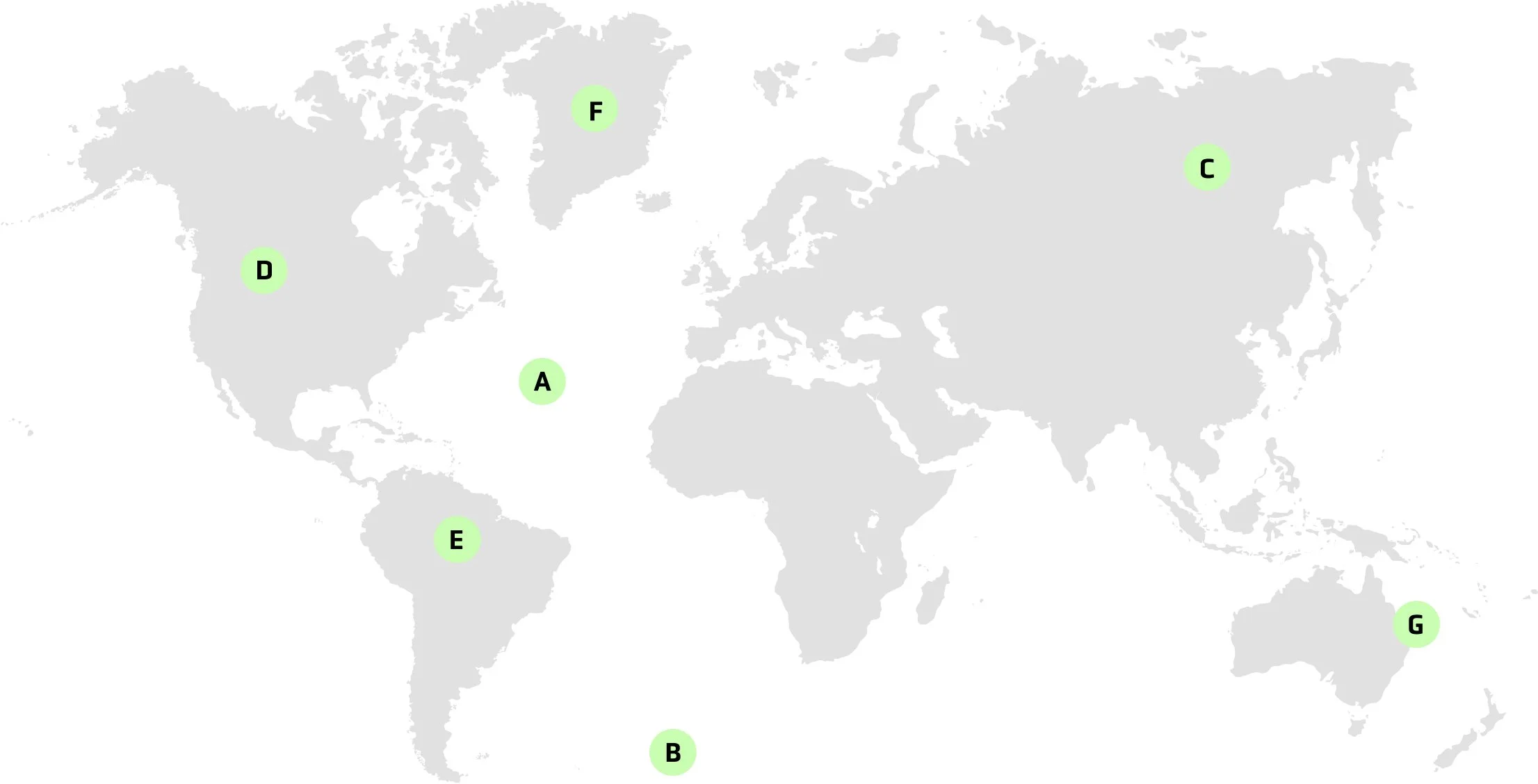
TIPPING POINTS ARE TIPPING
A Tipping Point in the Earth system is a critical threshold that, when exceeded, leads to large and often irreversible changes in the state of the system. As we move past these tipping points, it is imperative that we pursue every option for saving our planet.
A. Slowing of the Atlantic Meridional Oscillating Conveyer (AMOC)
B. Permafrost Thawing
C. Acceleration of Global Ice loss
D. Loss of Boreal Forests
E. Loss of Amazon Rainforest
F. Increase in Greenland Ice Melt
G. Decline of Coral Reef Ecosystems
The impact of our current trajectory toward an average surface temperature of 3C, by the end of this century, will be catastrophic. Solar geoengineering can buy us time, by subduing most impacts of climate change, to decarbonize the planet.
WE’VE GOT TO BUY TIME
We are facing multiple disasters because of climatic changes. These include:
-
Global South natives rely heavily on farming to feed for their family and create income. As a result of climate change, the weather is unpredictable, making it difficult to sustain healthy crops overtime. For example, monsoon cycles are becoming less frequent due to warming temperatures creating dry, arid soil/land. By 2050, countries will have stopped sharing food.
-
Housing infrastructure in the Global South is likely to be poor quality and incapable of withstanding extreme weather. Homes that are destroyed during these extreme weather events may not be repaired because most Global South residents lack the funds to do so. Lack of early warning measures cause lack of preparedness, death, and greater destruction.
-
Poor sanitation occurs after big disasters such as floods and tornadoes. This causes diseases to spread quickly.
Vulnerability to Heat.
Decrease in Health and Quality of Life.
Lack of access to food and water.
Every year, environmental factors take the lives of approximately 3 million people.
-
The world’s land, and its fresh water, is shrinking as the oceans expand.
In rural areas, shrinking sources of fresh water, droughts, and changes to the water cycle, make it difficult to get hold of clean water.
-
In densely populated cities, air pollution is a real problem. Cities with lots of cars driving around, and coal fired power stations exporting fumes can lead to heart and lung problems such as asthma and heart disease.
-
Due to the loss of 95% of our heat shield (melting of the Arctic and the mountain ranges such as the Himalayas, Andes, Alps etc.) frequency and intensity as fires around the world have increased. Humans are very Vulnerable to Heat. We can exist in a very small range of temperature. We will experience a decrease in Health and Quality of Life. Urban Heat Island Effect is the Most Dangerous Impact. Cities absorb heat due to the density of materials that make the city. Urban Heat Island Effect (UHIE) can create temperatures that are 6 C - 10 C hotter than their surrounds. UHIE is the most dangerous of all climate impacts. Given that by 2050, 70% of the Global population will be living in cities, UHIE will likely cause most of the fatalities in cities.
-
Disruption of life cycles. The loss of vegetation can cause desertification, soil erosion, fewer crops, flooding, and increased greenhouse gases in the atmosphere.
-
Peoples of Nations who live in Polar areas are experiencing the damage caused by the melting of the Arctic and Greenland Ice. They are now experiencing:
Loss of meltwater and loss of agriculture
Floods and Land Slides
Lack of clean water
Displacement and Migration
Permafrost Loss
-
As permafrost melts, it releases methane which plays a significant role in overheating the planet. Methane heats the world far more effectively than carbon dioxide. It has a “warming potential” of more than 80 times that of carbon dioxide.
Due to heat melting the permafrost, methane is now being released at higher amounts. The rapid escape of methane is a tremendous threat, not only to the people living in the North, but to the entire population of the Earth, which will be affected as methane release can create a ‘negative feedback loop’. As more methane is released, more heat is put in the atmosphere, causing the permafrost to melt even more, thus releasing more methane - and so on…
Also, as the Arctic Ice is melting, we are losing our “Sun Shield”. Because the Arctic is white and very reflective, it has helped to cool the Earth. As it decreases, the dark ocean is expanding and absorbing more heat, thus contributing more heat into the atmosphere.
-
Elevated atmospheric CO2 is absorbed by the oceans, causing ocean acidification. Thus, affecting extremely important marine ecosystems such as coral reefs which provide 50% -80% of the worlds’ oxygen. The combination of Ocean Acidification, caused by the ocean’s absorption of Carbon Dioxide emissions, along with a warming Ocean are creating major damage to our oceans which will have great impacts upon human life.
Loss of Ocean Ecosystems
Warming Oceans increase the ability of the Ocean to Dissolve Carbon Dioxide (DOC) thus making the oceans even more acidic, again, creating a “negative feedback loop.”
-
It is predicted that in the next 30 years (the year 2050), the U.S. coastline will be projected to rise on average 10-12 inches. As sea level rise continues to increase, safe drinking water will decrease because of the salt water and fresh water mixing within basins and wells.
Coastal Flooding
Salt-water Intrusion
Wetland Flooding
Agricultural Soil Contamination
Poor Infrastructure Health
-
-
More than half the world’s population live near the coast. Climate change is increasing the frequency and intensity of flooding, sea level rise, and storm surges. When those happen, it causes devastation and loss of life for the people living in these areas.
By 2050, 1.5 Billion people in India and Southeast Asia will have to migrate to the North due to Sea Level Rise and Glacier melt.
By 2100, 2.5 Billion in India and Southeast Asia will have to migrate to the North due to Sea Level Rise and Glacier melt.

“Even an immediate curb on greenhouse gas emissions doesn’t preclude warming of up to 7 degrees Fahrenheit by the end of the century because the current amount of warming could be magnified by big increases of heat-trapping methane in the Arctic or by changes to cloud processes.”https://insideclimatenews.org/news/08042020/global-warming-ecosystem-biodiversity
IF GLOBAL WARMING IS LEFT UNCHECKED
Almost All Impacts of Climate Change Are Caused by Global Warming
Given the slow progress of reducing CO2 emissions, the outcome of the past COP26 tells us that there is no scenario in which reducing carbon emissions alone will avert catastrophe. “If global warming continues unchecked, the heat that's coming later this century in some parts of the world will bring "nearly unlivable" conditions for up to 3 billion people.”
The authors predict that by 2070, much of the world's population is likely to live in climate conditions that are "warmer than conditions deemed suitable for human life to flourish." The study warned that unless greenhouse gas emissions are curtailed, average annual temperatures will rise beyond the climate "niche" in which humans have thrived for 6,000 years.
Many Temperature and Precipitation Extremes Are Becoming More Common
Global warming of 1.5 C and 2 C will exceed during the 21st century unless deep reductions occur. We will experience climate extremes in all regions across the globe.
“Global warming is about to tear big holes into Earth’s delicate web of life, pushing temperatures beyond the tolerance of thousands of animals at the same time. As some key species go extinct, entire ecosystems like coral reefs and forests will crumble, and some will collapse abruptly, starting as soon as this decade, a new study in the journal Nature warns.”
“Ocean Warming Is Speeding Up, with Devastating Consequences. This study shows in 25 years, the oceans have absorbed heat equivalent to the energy of 3.6 billion Hiroshima-size atom bomb explosions, the study's lead author said. The world’s oceans are warming at a rapidly increasing pace, new research shows, and the heat is having devastating effects on marine life and intensifying extreme weather.”
“As global temperatures rise, time is running out. The cryosphere—areas of the planet that are frozen—is shrinking as glaciers and sea ice melt, snowpack declines and permafrost thaws. At the same time, oceans have absorbed 90 percent of the excess heat and about a quarter of the carbon dioxide from human activities, leading to greater acidification that harms shellfish and corals and lowers oxygen levels in the water.”
Even Best-Case Scenario Will See Damage
“Even if greenhouse gas emissions were stopped tomorrow, the warming impacts of what has already been emitted will continue. That means that a best-case, low-emissions scenario for the future will still see some significant impacts, especially for coastal communities.”